

Mountain Corridor

The Issue:

Interstate 70 through the Rocky Mountain front range is a major highway carrying commerce and passengers of all varieties.  It is the main truck route for goods to Summit County and towns on the West Slope.   It is also a main east-west throughway for long haul trucks that just pass through Colorado.

I-70 also serves the many Colorado Ski Resorts including Vail, Aspen, Winter Park, Keystone, Breckenridge and others.  Weekend ski traffic is very heavy in both directions.   In the summer I-70 is also the gateway into the Rocky Mountains for campers, bikers, hikers, climbers, kayakers, floaters and many recreational users. Summer recreational traffic is actually higher than winter ski traffic although spread out more..

Constraints:

Much of I-70 cuts through narrow valleys where there is little room to add even a single additional lane.  Even where lanes can be added the cost is high and there are serious rockslide issues from extreme slopes.  The mountain pass is also steep with 7 and 8 percent grades and truck run away lanes.   Winter weather on I-70 can be extremely challenging with frequent snowfall and sudden blizzards.   The pass is usually shut down several times a year.  Severe weather slows traffic, increases the risk of accidents.

There are also several short tunnels and the long Eisenhower Tunnel over the continental divide.  The very existance of tunnels slows traffic.

In October, 2010, CDOT and the FHWA prepared a Draft Programmatic Environmental Impact Statement on the I-70 Mountain Corridor.  Here you will find a link to PDF of the summary slide show.

Our goal on this website page is not only to outline the I-70 corridor issues, but also to provide a space to add additional information about the problem and solutons as they are developed.

Ellusive Solutions

There is no simple solution to I-70 congestion.  All simple solutions have been tried.   Instead there are a range of expensive and in some cases, dubious strategies that will impact the problem.

More Lanes & Other Roadway Improvements.

congestionWhile improving the I-70 infrastructure is difficult and expensive, there are engineering solutions.   In the 2010 PEIS, CDOT outlines  a plan that would involve:

  • More than 20 interchange improvements
  • 25 miles of additional auxiliary lanes
  • New tunnel bores at the twin tunnels and the Eisenhower-Johnson memorial tunnels.
  • Truck operations improvements, such as chain-up stations.

CDOT also points out that there are other alternatives to encourage changes in travel patterns without expensive highway construction.  Logically these alternatives need to be investigated and even tried prior to extensive enhancement of the infrastructure.


I-70 Speed Harmonization Begins on December 18th.

I-70The Colorado Department of Transportation (CDOT), in coordination with the Colorado State Patrol (CSP), Silverthorne Police Department (SPD), Clear Creek County Sheriff (CCCS), and Idaho Springs Police Department (ISPD), will begin the winter season implementation of Rolling Speed Harmonization this weekend.  It will run on eastbound Interstate 70, from Silverthorne to Floyd Hill. 

Beginning sometime between 11 a.m. and noon, on Sunday, December 18, a single SPD car will switch on its emergency lights and merge ahead of traffic, starting just east of the Silverthorne Interchange.  The police vehicle then will pace eastbound vehicles, at speeds between 45 and 55 mph, to the entrance of the Eisenhower/Johnson Memorial Tunnel (EJMT). 

The SPD then will hand-off to the CSP inside the tunnel, with the CSP pacing vehicles through the EJMT and east to Georgetown.  At that point, the CCCS will take over, pacing vehicles to Downieville, with the ISPD continuing the operation to the U.S. 6 junction, at the bottom of Floyd Hill, where eastbound I-70 expands to three lanes.  

A new pace group is expected to leave Silverthorne about every five to 10 minutes, with operations continuing along the 39-mile segment through mid-afternoon,

Implementation follows two previous tests of the program – on Saturday, August 13, from Silverthorne to the EJMT, and Sunday, September 25, from Silverthorne to Empire Junction.  Data collected from those tests indicated Rolling Speed Harmonization created more uniform vehicle speeds, helping to improve safety, reduce traffic crashes and improve traffic flow on the corridor.  It also showed very high compliance and that speed differentials were reduced, even between vehicle groupings – a key determinant since wide variations in speed lead to higher probability of accidents which, in turn, substantially increases congestion. 
     
“Given the successful tests we had earlier this year, we wanted to take this opportunity to run harmonization before the anticipated higher traffic volumes during the upcoming holidays and weekends,” said CDOT Regional Transportation Director Tony DeVito.  “Using it is a temporary measure but it’ll verify that this tool can be operated in varying road and weather conditions. We’ll continue to monitor and evaluate the program for any necessary improvements.  We’re also using it as a way to reduce the need to meter at the tunnel.”

Eastbound traffic is held or “metered” at the tunnel when vehicle volumes exceed the capacity of I-70.  When back-ups occur, CDOT stops vehicles from entering the tunnel, allowing traffic to clear, before releasing more traffic into the tunnel. 
CDOT supports the program by paying 24 off-duty officers overtime, at an approximate cost of $4,500 to $5,000.

After Sunday’s operation, CDOT resumes Rolling Speed Harmonization on Sunday, January 1.  It is scheduled to continue on Sundays or Mondays (Martin Luther King Jr. Day/President’s Day) through the 2012 ski season. 


Toll Roads

I-70 TollpikeThere is no plan to convert I-70 into a toll road, but the idea of controlling traffic congestion by increasing the cost of travel has been considered. The idea tends to be unpopular because the entire idea of commerce in Colorado is to encourage travel into the mountains for skiing and other recreation.  Peak Travel period tolling is also an unpopular concept in the U.S.

Interestingly enough the rising cost of fuel may have the same effect as a toll road by encouraging more car pooling and bus traffic to the ski areas.

It is also clear that stiff tolls on trucks could divert long haul traffic to I-80 in Wyoming, but that would also effectively increase the cost to move goods into Summit county and the ski areas while also increasing cost to move produce from the Western Slope to the Front Range.  While a small toll would have little impact on traffic congestion, larger tolls have large economic disincentives well beyond congestion issues.

Ban Trucks

Truck BanDoes it make sense to ban trucks from I-70 at peak congestion periods, particularity on ski weekends?  The evidence does not suggest that truck traffic is the root cause of I-70 congestion.  Truck traffic is also somewhat self regulating since drivers and motor carriers will try to travel the corridor during the lightest traffic periods.

Spending 3 to 4 hours in traffic is a major inconvenience to skiers, but a significant economic disincentive to the motor carrier industry.  Baning trucks would also add to the cost of goods in Summit County by increasing the transportation costs.

CMCA has opposed a ban of any nature for trucks on I-70 because of not only the consequences for trucking but its impact on other businesses as well as our overall state and national economy that depends on this vital corridor for transport of goods.

While the concept of banning trucks for certain periods on the weekend is appealing to some politicians and some of the general public, the issue is much more complex and difficult than they realize and may create a series of other problems, unanticipated consequences, associated costs, and challenges. Truck drivers must comply with hours of service requirements and taking a 3 or 4 hour timeout for a curfew, translates into delivery schedules not being met or drivers running out of hours in the middle of the mountains. Also, there is the issue of truck parking. Where do you put several hundred trucks during this proposed curfew? The state already lacks enough truck parking. Add to this the fact that this would occur in the middle of winter and drivers would be idling these vehicles, using more fuel and creating greater emissions, all at a time when we are trying to reduce both.

More importantly, will it make a difference on traffic on I-70. Truck drivers and companies already seek to avoid these peak periods. If they are out there, it is because they need to be. Based on discussions with transportation professionals, truck traffic during those peak weekend periods constitutes less than 2% of the overall traffic. The fact is that truck traffic volumes on I-70 and throughout the country were at some of the lowest levels over the past two years yet problems on I-70 in the mountains during these weekend periods got worse.

On CMCA's part we are looking to work with our members and our shippers to see how we can further realign our truck traffic to avoid these weekend periods because it may benefit all of us. At the same time though the reality is that the industry creating the congestion, the ski industry, needs to step up to the plate and implement actions to spread the ski traffic into lower traffic volume timeframes and provide incentives for public transit to those areas.


Rail - Monorail

monorailAlso called an "Advanced Guideway System", the idea is to add another mode of transit to address capacity issues. CDOT has pointed out that even a maximum highway build-out might not solve congestion problems. "Lack of capacity may lead to congestion, but improving capacity doesn't necessarily reduce congestion.  Transit addresses capacity, and highway improvements address congestion. 

The advanced guideway system, in theory, would allow easily moving larger numbers of skiers to the Summit county ski resorts and remove their vehicles from I-70.  Capacity would be greatly expanded and I-70 congestion reduced.  While studies are underway, the Advanced Guideway System suffers from significant financal issues as well as unresolved technical issues concerning operation on steep grades and snowy, icy weather.  It is unlikely to be a quick or easy fix to corridor issues.


"Got Chains" Program Underway

CMCA is working with the Colorado Department of Transportation (CDOT) and the Colorado State Patrol on a “Got Chains” campaign with the goal of reducing truck incidents on I-70 and increasing compliance with the chain law.  The campaign will feature several public service announcements that may be aired this winter both on a local basis and hopefully a national basis. In addition the campaign will also include various other materials for distribution to trucking companies, drivers and truckstops.

  The placemat below has been printed and distributed to various truckstops that cater to drivers approaching the I-70 mountain corridor.  The placemat describes the Colorado chain requirements, the locations where chains are required, and peak travel times to avoid.

Got Chains

Training Opportunities

Training 2012CMCA Offers a rich variety of training opportunities for both members and non-members.  The modern CMCA training center in Denver is the location of most seminars.  As demand warrants, CMCA also conducts seminars at other locations around the state.  Take a look at this year's seminars on the training page.

2012 CMCA Convention

2012 Convention

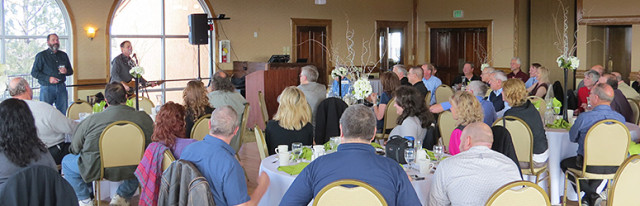
A highlight of the CMCA year is the annual CMCA convention. It is a chance for members to network and renew their knowledge of CMCA programs and successes.

The 2012 annual meeting will be held September 20-22 at the Ritz-Carton Bachelor Gulch, Avon, Colorado at peak fall foliage.

CMCA staff is working to line up speakers for the event. Online registration will open in June 2012. There is a dedicated page on this website to provide details of the convention.